
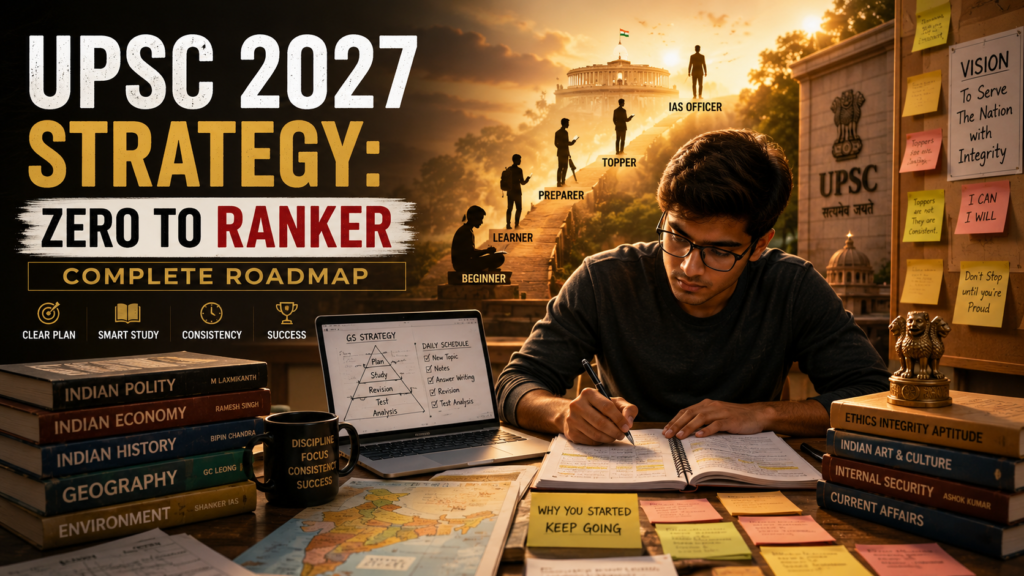
Every year, lakhs of aspirants begin their journey to crack the Civil Services Examination, but only a few achieve their dream of becoming an IAS, IPS, or IFS officer. The difference between an average aspirant and a successful candidate is not just hard work — it is the right strategy, consistency, and disciplined execution.
If you are starting your preparation now, this UPSC 2027 Strategy blog will help you build a clear roadmap from beginner level to ranker level. Whether you are in college, doing a job, or preparing full-time, a smart and systematic plan can significantly improve your chances of success.
Understanding the UPSC Exam Structure
Before starting preparation, it is important to understand the three stages of the UPSC Civil Services Examination:
1. Prelims Examination
- Objective type exam
- Two papers: GS Paper I and CSAT
- Screening nature
2. Mains Examination
- Descriptive written examination
- 9 papers including Essay, GS Papers, Optional Subject, and Language Papers
3. Personality Test (Interview)
- Tests personality, decision-making ability, communication skills, and awareness
A successful candidate prepares for all three stages together rather than separately.
Step 1: Build a Strong Foundation (2025–2026)
The first phase of your UPSC 2027 Strategy should focus on building conceptual clarity.
Start with NCERT Books
NCERTs are the backbone of UPSC preparation. Begin with:
- History
- Geography
- Polity
- Economics
- Science
- Sociology
Read NCERTs from Class 6 to 12 selectively and make short notes.
Important Tip:
Do not rush toward advanced books immediately. A strong foundation is what creates future rankers.
Read Newspapers Daily
Current affairs play a major role in UPSC preparation.
You should read:
- National news
- International relations
- Economy
- Environment
- Government schemes
- Editorial analysis
Develop the habit of making concise notes for revision.
Step 2: Standard Books & Core Preparation
Once basics are completed, move toward standard reference books.
Recommended Books
Polity
- M. Laxmikanth
Modern History
- Spectrum by Rajiv Ahir
Geography
- G.C. Leong + Atlas
Economy
- Basic concepts + current affairs integration
Environment
- Current-based preparation
Ethics
- Case study practice + examples
The key is revision, not collecting too many books.
Step 3: Create a Smart Study Schedule
Time management is one of the most important parts of the UPSC 2027 Strategy.
Ideal Daily Routine
Morning
- Newspaper reading
- Current affairs notes
Afternoon
- Static subject preparation
Evening
- Answer writing / MCQ practice
Night
- Revision
Study hours matter less than consistency and productivity.

Step 4: Master Answer Writing
Many aspirants prepare well but fail to present answers effectively in Mains.
How to Improve Answer Writing
- Practice daily
- Write structured answers
- Use headings and subheadings
- Add diagrams and flowcharts
- Include examples and case studies
Initially, your answers may feel weak, but regular practice creates improvement over time.
Step 5: Prelims Preparation Strategy
Prelims is often considered the toughest filtering stage.
Important Areas
- Current affairs
- Polity
- Environment
- Modern history
- Economy basics
- Maps and geography
Practice Mock Tests
Solve:
- Topic-wise MCQs
- Full-length mock tests
- Previous year questions
Revision is the ultimate weapon for Prelims success.
Step 6: Optional Subject Selection
Your optional subject can significantly influence your final rank.
Choose an optional based on:
- Interest
- Availability of resources
- Guidance
- Overlap with GS
- Previous academic background
Never choose an optional only because someone else scored high in it.
Step 7: Develop Consistency & Discipline
The UPSC journey is long and emotionally challenging.
During preparation:
- Avoid comparison
- Limit social media distractions
- Focus on self-improvement
- Stay physically and mentally healthy
Remember, consistency beats intensity.
Even studying 6–8 focused hours daily for two years can create extraordinary results.
Step 8: Revision Strategy
Without revision, preparation remains incomplete.
Effective Revision Techniques
- Short notes
- Mind maps
- Flashcards
- Monthly current affairs revision
- PYQ analysis
Aspirants often study continuously but revise very little. Rankers revise multiple times.
Step 9: Interview Preparation
The final stage tests personality, not just knowledge.
Key Areas for Interview
- DAF (Detailed Application Form)
- Communication skills
- Situational judgment
- Current affairs
- Confidence and honesty
Mock interviews help improve body language and articulation.
Common Mistakes to Avoid
While following your UPSC 2027 Strategy, avoid these mistakes:
- Reading too many sources
- Ignoring answer writing
- Lack of revision
- Following multiple strategies
- Unrealistic study targets
- Neglecting health and sleep
A simple and sustainable strategy works better than a complicated one.
Role of Self-Analysis
Every month, evaluate:
- What you studied
- Weak subjects
- Mock test performance
- Time management issues
Self-analysis helps you improve continuously.
Final 1-Year Plan Before UPSC 2027
2026 Mid to End
- Complete syllabus once
- Begin serious answer writing
- Join test series if needed
Early 2027
- Focus heavily on revision
- Solve PYQs
- Attempt mock tests regularly
Before Prelims
- Avoid new sources
- Revise notes repeatedly
- Practice elimination techniques
Conclusion
Cracking UPSC is not about being a genius; it is about discipline, patience, and smart execution. Your journey from zero to ranker starts with a single step taken consistently every day.
This UPSC 2027 Strategy is designed to help aspirants create a balanced preparation plan covering Prelims, Mains, and Interview together. Stay focused, trust the process, and keep improving gradually.
Remember:
Small daily improvements create massive long-term success.
Your UPSC 2027 journey starts today.
Why Guidance & Mentorship Matter in UPSC Preparation
A structured preparation journey becomes easier when you have the right guidance, proper strategy, regular mentorship, and continuous evaluation. Many aspirants waste valuable time due to lack of direction, poor planning, and confusion between multiple resources.
At Kesari IAS, aspirants are guided through a systematic preparation approach designed for both beginners and serious UPSC candidates. From subject planning and current affairs guidance to answer writing practice and mentorship support, a focused ecosystem can help students stay consistent throughout the preparation journey.
Kesari IAS Mentorship Support Includes:
- Personalized preparation guidance
- Study planning & strategy sessions
- Answer writing improvement
- Current affairs support
- Motivation & consistency tracking
- Regular tests and performance evaluation
🔗 Visit the official website: Kesari IAS Home Page
📞 Contact & Counseling: Kesari IAS Contact Page
If you are preparing for Civil Services Examination, the right mentorship can help transform your preparation from directionless study to result-oriented learning.
Start your UPSC 2027 journey with clarity, discipline, and the right roadmap.