
In the 21st century, technological supremacy is increasingly defined by advancements in cutting-edge fields such as artificial intelligence, space technology, and quantum science. Among these, quantum technology is considered the next frontier, capable of revolutionizing computing, communication, and data security. Recognizing its immense potential, the Government of India launched the National Quantum Mission (NQM) in April 2023 as a strategic initiative to position the country at the forefront of the global quantum revolution.
The mission represents a bold step toward building a robust ecosystem for quantum research, innovation, and industrial applications. With a financial outlay of approximately ₹6003.65 crore and a timeline extending from 2023–24 to 2030–31, the initiative aims to accelerate India’s progress in quantum technologies and ensure long-term technological and economic competitiveness.
Understanding Quantum Technology
Before exploring the mission in detail, it is essential to understand what quantum technology entails. Unlike classical computing, which uses bits (0 or 1), quantum computing relies on qubits, which can exist in multiple states simultaneously due to principles such as superposition and entanglement. This enables quantum systems to process vast amounts of data at unprecedented speeds.
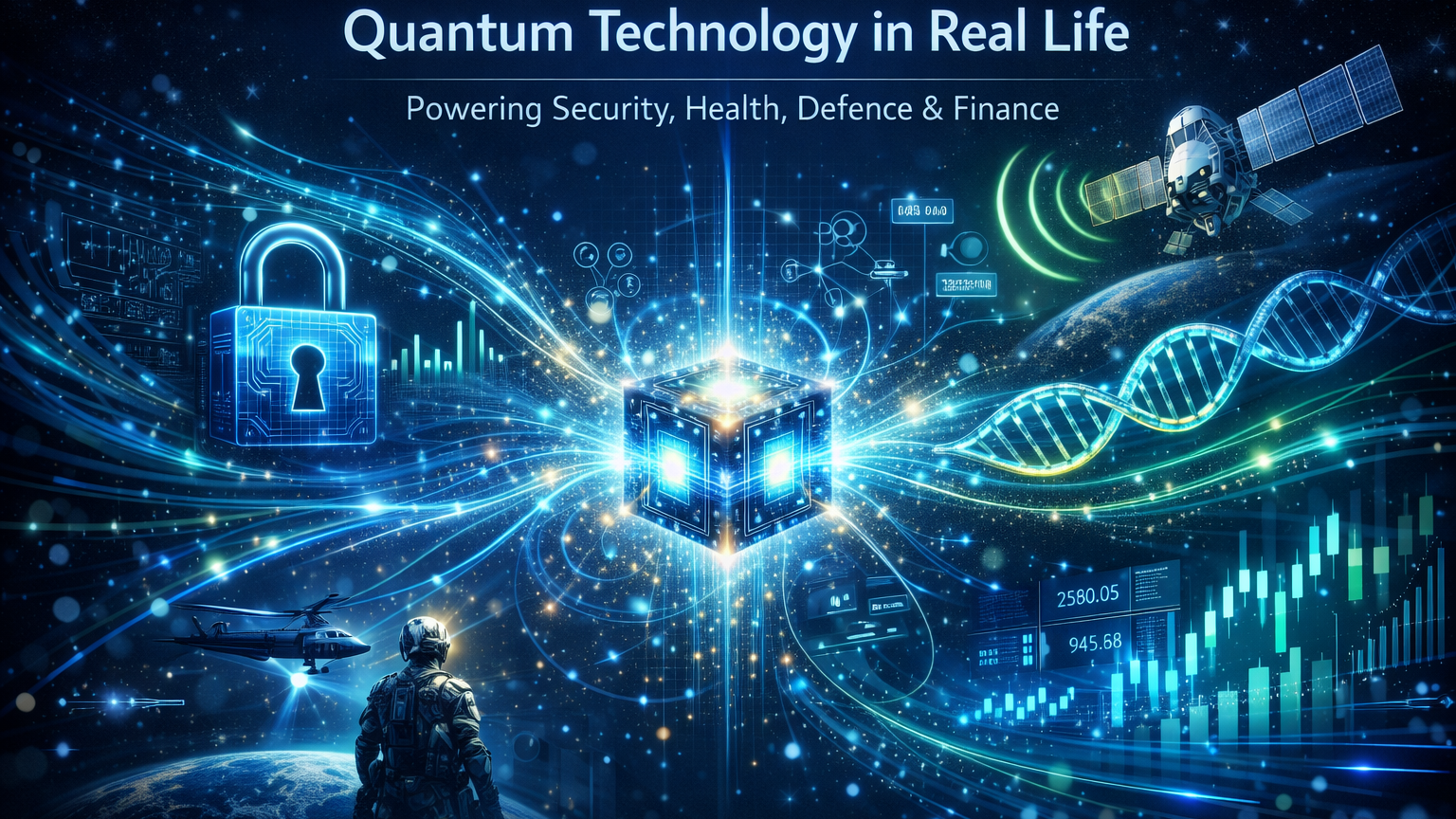
Quantum technology has applications in multiple domains, including cryptography, healthcare, climate modeling, financial systems, and defense. Its transformative potential is comparable to the advent of the internet or artificial intelligence.
Objectives of the National Quantum Mission
The National Quantum Mission has been designed with a comprehensive and forward-looking vision. Its primary objective is to create a strong scientific and industrial ecosystem in quantum technologies, enabling India to emerge as a global leader in this field.
The mission focuses on four key domains:
1. Quantum Computing
One of the central goals is to develop intermediate-scale quantum computers with 50–1000 physical qubits over the next decade.
These systems are expected to solve complex computational problems that are beyond the capabilities of classical computers, such as molecular simulations, optimization problems, and cryptographic analysis.
2. Quantum Communication
The mission aims to establish highly secure communication systems based on quantum principles. This includes the development of quantum key distribution (QKD) networks and satellite-based quantum communication links over distances of up to 2000 kilometers.
Such systems are virtually immune to hacking, making them critical for national security and data protection.
3. Quantum Sensing and Metrology
Another focus area is the development of high-precision sensors and measurement devices. These technologies can significantly improve navigation systems, medical imaging, geological surveys, and defense applications.
4. Quantum Materials and Devices
The mission also emphasizes the development of advanced materials and hardware necessary for quantum systems, such as superconductors and photonic devices. Building indigenous capabilities in this area is crucial for reducing dependence on foreign technologies.
Institutional Framework and Implementation
To achieve its ambitious goals, the National Quantum Mission has established a structured institutional framework. One of its key features is the creation of Thematic Hubs (T-Hubs) in different domains of quantum technology, including computing, communication, sensing, and materials.
These hubs are being set up in leading academic and research institutions such as IITs, IISc, and national laboratories. They serve as centers of excellence, fostering collaboration among scientists, researchers, startups, and industry stakeholders.
The mission also encourages partnerships between academia, government, and private enterprises to create a vibrant innovation ecosystem. By integrating research with practical applications, it aims to bridge the gap between theoretical science and real-world technology deployment.
Strategic Importance of the Mission
The National Quantum Mission is not just a scientific initiative; it is a strategic investment in India’s future. Its significance can be understood across multiple dimensions:
1. Strengthening National Security
Quantum communication technologies can provide ultra-secure communication channels, making it extremely difficult for adversaries to intercept or hack sensitive information.
2. Economic Growth and Innovation
Quantum technologies have the potential to create new industries, generate employment, and drive economic growth. By investing early, India can become a hub for quantum innovation and attract global investments.
3. Technological Self-Reliance
The mission aligns with the vision of Atmanirbhar Bharat by promoting indigenous development of advanced technologies. This reduces dependence on foreign imports and enhances strategic autonomy.
4. Global Competitiveness
With countries like the United States, China, and members of the European Union investing heavily in quantum research, the mission ensures that India remains competitive on the global stage. Notably, India has become one of the few countries with a dedicated national quantum initiative.
Challenges and Limitations
Despite its ambitious vision, the National Quantum Mission faces several challenges:
- High Cost and Infrastructure Needs: Quantum research requires significant investment in advanced laboratories and equipment.
- Shortage of Skilled Workforce: There is a need to develop expertise in quantum physics, engineering, and related fields.
- Technological Complexity: Quantum systems are highly complex and still in the experimental stage globally.
- Global Competition: Rapid advancements by other countries increase the pressure to deliver timely results.
Addressing these challenges will require sustained funding, policy support, and international collaboration.
Future Prospects
The future of the National Quantum Mission looks promising. As the mission progresses, it is expected to:
- Develop scalable quantum computers
- Establish nationwide quantum communication networks
- Promote startups and innovation in quantum technologies
- Train a new generation of scientists and engineers
In the long run, quantum technology could transform industries such as pharmaceuticals, logistics, cybersecurity, and artificial intelligence, making India a key player in the global technology landscape.
Conclusion
The National Quantum Mission marks a significant milestone in India’s journey toward technological advancement. By investing in quantum technologies, the country is preparing for a future where computing power, data security, and scientific innovation will define global leadership.
While challenges remain, the mission’s comprehensive approach—spanning research, infrastructure, and collaboration—provides a strong foundation for success. If implemented effectively, it has the potential to revolutionize India’s technological capabilities and position it as a global hub for quantum innovation.
In essence, the National Quantum Mission is not just about embracing a new technology; it is about shaping the future of science, security, and economic growth in India.
🔹 Empower Your UPSC Journey
Just as initiatives like the National Quantum Mission are shaping India’s future, your preparation for UPSC requires foresight, strategy, and expert guidance. Staying updated with current affairs, understanding key developments, and building a strong conceptual foundation can make all the difference.
Kesari IAS Mentorship offers personalized guidance, structured study plans, and continuous support to help you navigate your UPSC preparation with confidence. Take the next step toward your goal with the right mentorship and turn your aspirations into achievement.