
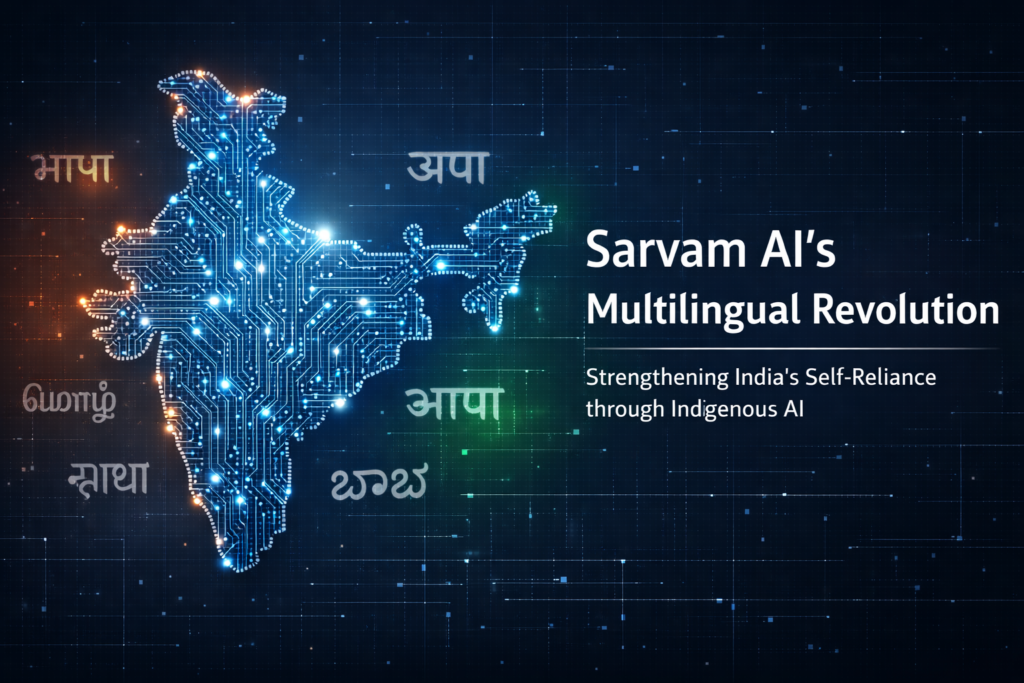
In recent years, Artificial Intelligence (AI) has emerged as one of the most transformative technologies shaping global economies, governance structures, and societal progress. For a culturally rich and linguistically diverse nation like India, AI presents both a challenge and an unprecedented opportunity. Sarvam AI’s Multilingual Revolution: Strengthening India’s Self-Reliance through Indigenous AI is a strategic milestone in India’s quest to harness AI not just as an imported tool, but as a homegrown technology that empowers citizens in their own languages, safeguards digital sovereignty, and drives inclusive national development.
🌏 Why Multilingual AI Matters in India
India is a mosaic of more than 1.4 billion people speaking hundreds of languages and dialects. While English and a handful of global languages dominate mainstream AI systems, the majority of Indians communicate, learn, transact, and access public services in regional languages. This linguistic complexity underscores why Sarvam AI’s Multilingual Revolution: Strengthening India’s Self-Reliance through Indigenous AI is not merely a tech initiative, but a socio-economic and cultural imperative.
Traditional AI models often struggle with local scripts, voice nuances, and region-specific contexts — especially in languages like Hindi, Tamil, Telugu, Bengali, Marathi, and many others. Closing this gap means moving beyond the limitations of generic global models and building AI systems that truly resonate with Indian realities.
🤖 Sarvam AI: India’s Homegrown AI Powerhouse
Founded in 2023 in Bengaluru by researchers including Dr. Vivek Raghavan and Dr. Pratyush Kumar, Sarvam AI is an Indian tech company focused on sovereign and multilingual AI models tailored to the Indian context.
Unlike many Western AI platforms, Sarvam’s models are built from the ground up in India, trained on diverse datasets that integrate Indian languages, literary sources, governance terminology, code-mixed text like Hinglish, and dialectal variations. This native design philosophy anchors Sarvam AI’s Multilingual Revolution: Strengthening India’s Self-Reliance through Indigenous AI in linguistic inclusivity and national autonomy.
🧠 What Makes Sarvam AI Unique?
- Indigenous Large Language Models (LLMs)
Sarvam AI has built foundational AI models with billions of parameters that support real-world tasks like language translation, extended dialogues, complex reasoning, and voice interactions — all optimized for India’s linguistic spectrum. - Multimodal Capabilities
Beyond text, Sarvam’s models handle voice, script recognition, and even vision tasks such as OCR (Optical Character Recognition) that decode mixed content documents in Indian languages — an essential feature for digitizing public records, historical archives, and official forms. - Voice-First Interaction
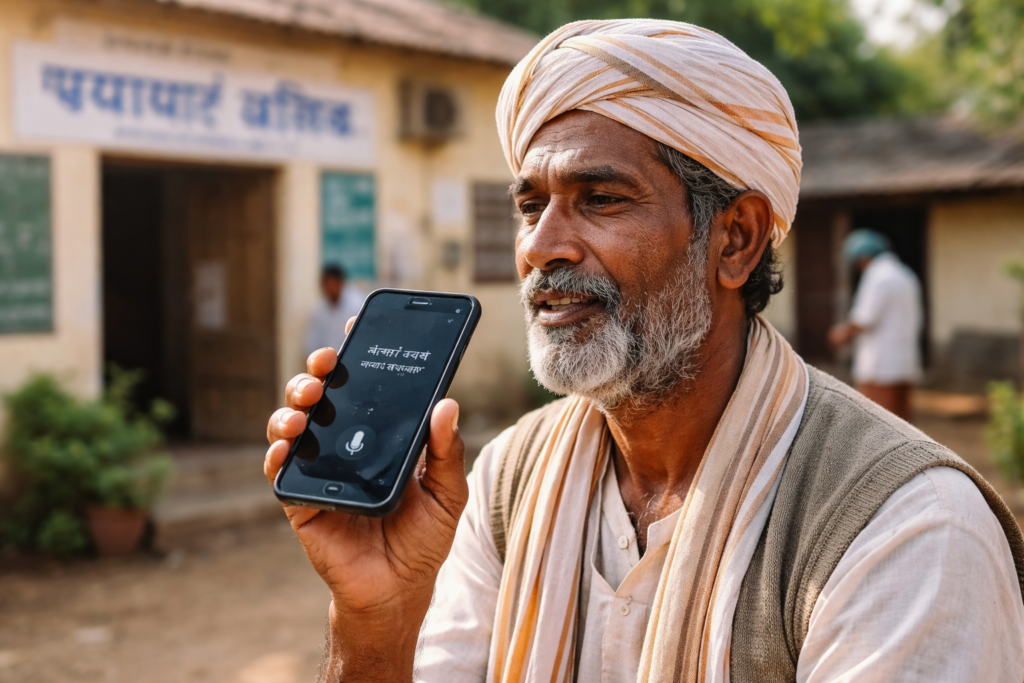
Recognizing that many Indians prefer speaking over typing, Sarvam’s AI systems are designed to understand and respond to spoken language, bridging critical accessibility gaps. - Sovereign Infrastructure
Sarvam AI’s models are powered by India-based infrastructure, meaning data stays within national borders and complies with domestic regulations — a cornerstone of Sarvam AI’s Multilingual Revolution: Strengthening India’s Self-Reliance through Indigenous AI.
🪪 AI and Self-Reliance: A Strategic Advantage
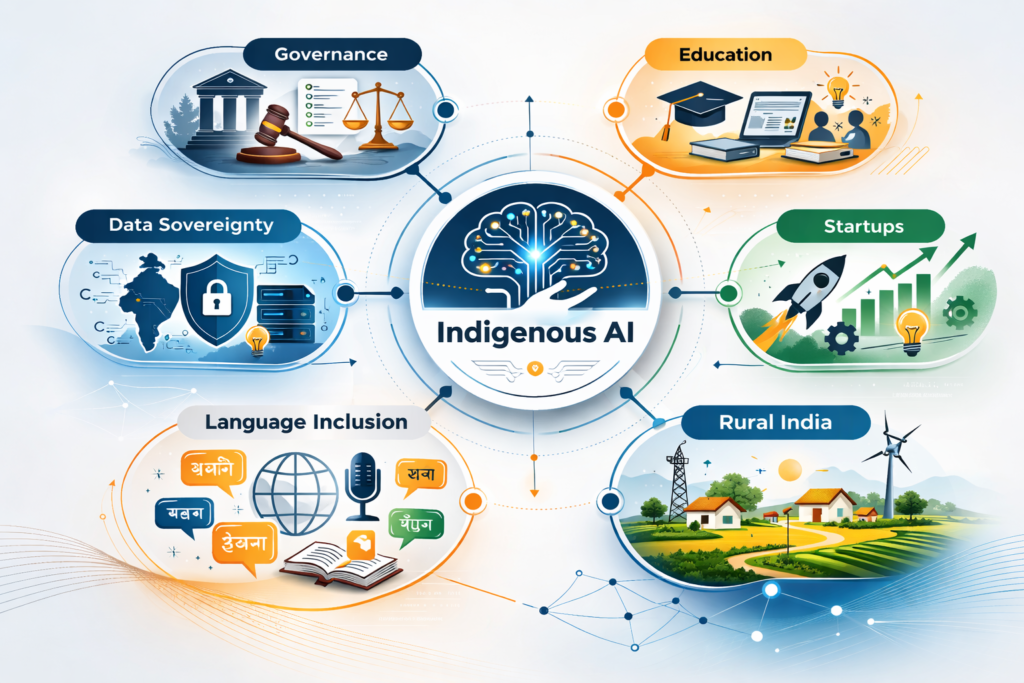
As part of India’s technology strategy, initiatives such as Atmanirbhar Bharat and the IndiaAI Mission emphasize building domestic AI capabilities that reduce dependence on foreign providers. Sarvam AI’s Multilingual Revolution: Strengthening India’s Self-Reliance through Indigenous AI aligns perfectly with these national goals by ensuring that core AI technologies — the very engines of automation, data processing, and decision support — are rooted in India’s own research ecosystem.
This reduces foreign dependency, enhances data sovereignty, and positions India as a competitive player in the global AI landscape. With Sarvam AI selected as a key partner under government-backed AI programs, India is beginning to assert its presence in the foundational technology that will define future economic and strategic power.
📚 Impact on Governance and Public Services
One of the most powerful implications of Sarvam AI’s Multilingual Revolution: Strengthening India’s Self-Reliance through Indigenous AI is its potential to revolutionize governance. AI systems that understand regional languages can:
- Translate policy documents, announcements, and guidelines into local languages
- Provide AI-powered chatbots that explain government schemes in simple regional terms
- Support citizen services through voice-enabled systems accessible to rural populations
- Enable real-time conversational assistance across departments
By making public services accessible in citizens’ native languages, the government can ensure higher participation, reduced bureaucratic friction, and more equitable access to welfare initiatives.
📘 Boosting Education and UPSC Preparation
For UPSC aspirants — especially those from Hindi and regional language backgrounds — AI offers a game-changing approach. Multilingual AI models can:
- Translate study material into regional languages
- Summarize NCERTs, reports, and policy documents
- Explain complex concepts through interactive conversational AI
- Generate mock tests and feedback in aspirants’ preferred language
This kind of personalized, language-inclusive support reduces barriers for aspirants from non-English mediums and aligns with India’s broader educational equity goals.
🚀 Driving Innovation Across Sectors
Sarvam AI’s Multilingual Revolution: Strengthening India’s Self-Reliance through Indigenous AI has implications far beyond governance and education. Businesses, startups, and services across sectors can use Sarvam’s multilingual tools for:
- Customer support via WhatsApp or voice agents
- Automated translation for e-commerce content
- Regional marketing and localized advertising strategies
- Accessibility solutions for differently-abled users
By equipping Indian enterprises with powerful AI tools that speak local languages, Sarvam is democratizing technology adoption across socio-economic strata.
🧩 Challenges & the Road Ahead
Despite its promise, building truly multilingual AI for India is fraught with challenges:
- High-quality datasets for low-resource languages are scarce
- AI research requires expensive computational infrastructure
- Ensuring ethical AI outcomes and fair representation remains complex
However, with collaborative efforts between government bodies, research institutions, and startups like Sarvam AI, these obstacles can be mitigated. The journey toward AI self-reliance — while challenging — is essential for India’s technological future.
🏁 Conclusion: A New Era of Inclusive Innovation
Artificial Intelligence will define how nations grow, govern, and connect with citizens. In this transformative era, strategies that embrace linguistic diversity, indigenous innovation, and digital sovereignty will shape the next chapter of India’s development.
Sarvam AI’s Multilingual Revolution: Strengthening India’s Self-Reliance through Indigenous AI is more than a technological breakthrough—it is a structural reform in India’s digital architecture. By building AI models that understand Indian languages, local governance systems, and socio-cultural realities, Sarvam AI is strengthening the foundation of an inclusive and self-reliant India.
For UPSC aspirants, this topic holds strong relevance for:
- GS Paper III (Science & Technology, Indigenization of Technology)
- GS Paper II (Governance & Digital Inclusion)
- Essay Paper (Technology and Self-Reliance, Inclusive Development)
- Interview Stage (AI Ethics, Data Sovereignty, Digital India)
Understanding initiatives like indigenous AI models helps aspirants connect technology with governance, economy, and social justice dimensions.
🎯 For Serious UPSC Aspirants
If you are preparing for UPSC or State PCS examinations and want structured guidance on emerging topics like AI, digital governance, Atmanirbhar Bharat, and India’s technology strategy, consistent mentorship can make a significant difference.
At Kesari IAS, we focus on:
- Concept clarity for GS Papers
- Linking current affairs with static syllabus
- Answer writing practice with structured feedback
- Interview-oriented issue analysis
Stay updated, stay analytical, and build multidimensional understanding — because in today’s exam landscape, technology topics like AI are no longer optional; they are scoring opportunities.